Walker Lake demo
This block of code is a temporary hack to show plotly plots inside the online documentation
[1]:
from IPython.display import HTML
HTML('<script type="text/javascript" src="https://cdnjs.cloudflare.com/ajax/libs/require.js/2.1.10/require.min.js"></script>')
[1]:
This block of code supress scrolling bars
[2]:
%%javascript
IPython.OutputArea.prototype._should_scroll = function(lines) {
    return false;
}
Importing necessary packages
[3]:
import pandas as pd
import pyLPM
Importing data
Importing data using datasets module
[4]:
wl = pyLPM.datasets.dataset('Walker_Lake')
Showing first 5 lines of the DataFrame
[5]:
wl.head()
[5]:
| X | Y | Cu | Au | |
|---|---|---|---|---|
| 0 | 11.0 | 8.0 | 0.000 | -999.0 |
| 1 | 8.0 | 30.0 | 0.000 | -999.0 |
| 2 | 9.0 | 48.0 | 2.244 | -999.0 |
| 3 | 8.0 | 69.0 | 4.344 | -999.0 |
| 4 | 9.0 | 90.0 | 4.121 | -999.0 |
Describing dataset
[6]:
wl = pd.read_csv(
    filepath_or_buffer='data/walker.csv',
    na_values=-999)
Plotting locations maps
[7]:
pyLPM.plots.locmap(
    x=wl.X,
    y=wl.Y,
    variable=wl['T'],
    categorical=True,
    title='Map for T')
[8]:
pyLPM.plots.locmap(
    x=wl.X,
    y=wl.Y,
    variable=wl.V,
    title='Map for V',
    pointsize=9)
[9]:
pyLPM.plots.locmap(
    x=wl.X,
    y=wl.Y,
    variable=wl.U,
    title='Map for U',
    colorscale='Bluered')
Plotting histograms
[10]:
pyLPM.plots.histogram(
    wl.V,
    title='histogram for V',
    n_bins=20)
[11]:
pyLPM.plots.histogram(
    wl.U,
    cdf=True,
    n_bins=20,
    title='histogram for U')
Plotting a scatterplot
[12]:
pyLPM.plots.scatter2d(
    x=wl.V,
    y=wl.U,
    title='Scatterplot UxV',
    xy_line=True)
[13]:
pyLPM.plots.scatter2d(
    x=wl.V,
    y=wl.U,
    variable=wl["T"],
    title='Scatterplot UxV',
    xy_line=False,
    best_fit_line=False)
Plotting a qq plot
[14]:
pyLPM.plots.qqplot(
    x=wl.V,
    y=wl.U,
    title='qq plot',
    x_axis='V',
    y_axis='U',
    pointsize=8,
    figsize=(700,700),
    dicretization = 200)
Running declus from GSLib
[15]:
pyLPM.gslib.declus(
    df=wl,
    x='X',
    y='Y',
    z=None,
    var='V',
    x_anis=1.0,
    z_anis=1.0,
    n_cell=50,
    min_size=5.0,
    max_size=45.0,
    keep_min = True,
    number_offsets=100,
    usewine=False)
DECLUS Version: 2.906

 data file = C:\Users\Roberto Rolo\Documents\pyLPM\py
 columns =           1           2           0           3
 tmin,tmax =   -1.000000E+21    1.000000E+21
 summary file = C:\Users\Roberto Rolo\Documents\pyLPM\py
 output file = C:\Users\Roberto Rolo\Documents\pyLPM\py
 anisotropy =        1.000000        1.000000
 minmax flag =          -1
 ncell min max =          50        5.000000       45.000000
 offsets =         100


There are      470 data with:
  mean value            =    435.29860
  minimum and maximum   =       .00000  1528.10000
  size of data vol in X =    243.00000
  size of data vol in Y =    283.00000
  size of data vol in Z =       .00000

  declustered mean      =    290.10570
  min and max weight    =       .28911     2.78945
  equal weighting       =      1.00000


DECLUS Version: 2.906 Finished

Stop - Program terminated.
Creating a grid
[16]:
grid = pyLPM.utils.autogrid(
    x=wl.X,
    y=wl.Y,
    z=None,
    sx=1,
    sy=1,
    sz=1,
    buffer=0)
Running NN from Geostat algorithms module
[17]:
resultsnn = pyLPM.geostatalgo.nn(
    x=wl.X,
    y=wl.Y,
    z=None,
    var=wl.V,
    grid=grid)
[18]:
pyLPM.plots.pixelplot(
    grid,
    resultsnn,
    title='NN results')
Plotting the declustered histograms
[19]:
wl.head()
[19]:
| Id | X | Y | V | U | T | Declustering Weight | |
|---|---|---|---|---|---|---|---|
| 0 | 1.0 | 11.0 | 8.0 | 0.0 | -999.0 | 2.0 | 2.771450 |
| 1 | 2.0 | 8.0 | 30.0 | 0.0 | -999.0 | 2.0 | 2.568608 |
| 2 | 3.0 | 9.0 | 48.0 | 224.4 | -999.0 | 2.0 | 1.948161 |
| 3 | 4.0 | 8.0 | 69.0 | 434.4 | -999.0 | 2.0 | 1.509497 |
| 4 | 5.0 | 9.0 | 90.0 | 412.1 | -999.0 | 2.0 | 1.371034 |
[20]:
pyLPM.plots.histogram(
    wl.V,
    title='Declustered histogram for V',
    wt=wl["Declustering Weight"])
[21]:
pyLPM.plots.histogram(
    resultsnn,
    title='NN Declustered histogram for V')
Variography
Plotting a H-scatter
[22]:
pyLPM.gammapy.hscatterplots(
    dataset= wl,
    X= 'X',
    Y= 'Y',
    head= 'V',
    tail= 'V',
    lagsize= 5.,
    nlags=3,
    azimuth= 160.,
    dip= 0.,
    lineartol= 2.5,
    htol= 22,
    vtol= 22,
    hband= 15.,
    vband= 15.,
    Z = None,
    choice = 1.0)
[23]:
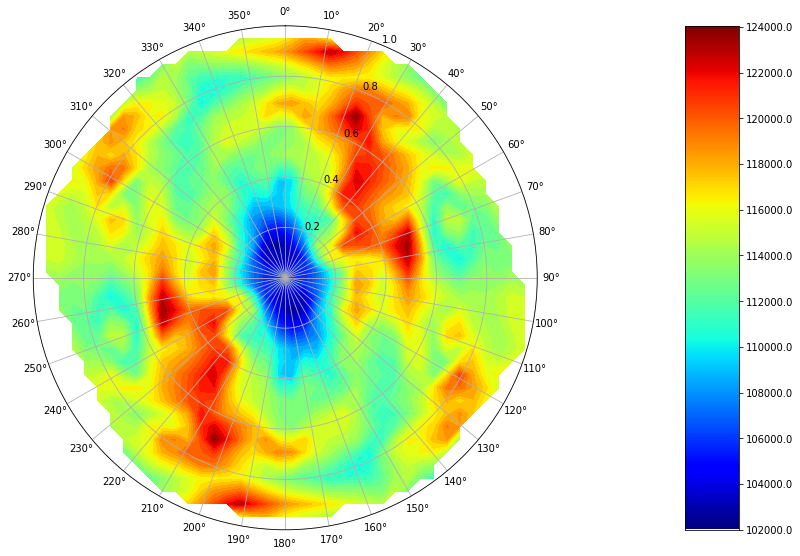
pyLPM.gammapy.varmap(
    dataset=wl,
    X='X',
    Y='Y',
    head='V',
    tail='V',
    azimuth=0.,
    dip=0.,
    nlags=10,
    lagdistance=10,
    ndirections=12,
    type_var='Variogram',
    Z=None,
    choice=1.0,
)
[24]:
exp_variogram = pyLPM.gammapy.experimental(
    dataset=wl,
    X='X',
    Y='Y',
    head='V',
    tail='V',
    type_c=['Variogram', 'Variogram'],
    nlags=[15,15],
    lagsize=[10,5],
    lineartol=[5,2.5],
    htol=[22,22],
    vtol=[22,22],
    hband=[10,10],
    vband=[10,10],
    azimuth=[166,76],
    dip=[0,0],
    omni=[False,False],
    show_pairs=True,
    Z=None,
    choice=1.0,)
[25]:
var_model = pyLPM.gammapy.modelling(
    experimental_dict=exp_variogram,
    rotation_max=166.,
    rotation_med=0.,
    rotation_min=0.,
    nugget=22000,
    inverted=False,
    rangemax=[30.,150.],
    rangemed=[25.,50],
    rangemin=[0.,0.],
    model=['Spherical','Spherical'],
    contribution=[40000.,45000.],
    show_pairs=False,)
Cross validation
[26]:
pyLPM.gslib.kt3d(
    df=wl,
    dh='Id',
    x='X',
    y='Y',
    z=None,
    var='V',
    grid=grid,
    variogram=var_model,
    min_samples=4,
    max_samples=18,
    max_oct=3,
    search_radius=[150,50,0],
    search_ang = [166,0,0],
    discretization = [5,5,1],
    krig_type='OK',
    sk_mean = 0,
    tmin=-1.0e21,
    tmax=1.0e21,
    option='cross',
    debug_level=0,
    usewine=False)
KT3D Version: 2.907

 data file = C:\Users\Roberto Rolo\Documents\pyLPM\py
 columns =           1           2           3           0           4
          0
 trimming limits =   -1.000000E+21    1.000000E+21
 kriging option =           1
 jackknife data file = C:\Users\Roberto Rolo\Documents\pyLPM\py
 columns =           2           3           0           4           0
 debugging level =           0
 debugging file = C:\Users\Roberto Rolo\Documents\pyLPM\py
 output file = C:\Users\Roberto Rolo\Documents\pyLPM\py
 nx, xmn, xsiz =         244        8.000000        1.000000
 ny, ymn, ysiz =         284        8.000000        1.000000
 nz, zmn, zsiz =           1    0.000000E+00        1.000000
 block discretization:          5           5           1
 ndmin,ndmax =           4          18
 max per octant =           3
 search radii =      150.000000       50.000000    0.000000E+00
 search anisotropy angles =      166.000000    0.000000E+00    0.000000E+00
 ktype, skmean =          0    0.000000E+00
 drift terms =           0           0           0           0           0
          0           0           0           0
 itrend =           0
 external drift file = extdrift.dat
 variable in external drift file =           4
 nst, c0 =           2    22000.000000
 it,cc,ang[1,2,3];           1    40000.000000      166.000000    0.000000E+00
   0.000000E+00
 a1 a2 a3:       30.000000       25.000000    0.000000E+00
 it,cc,ang[1,2,3];           1    45000.000000      166.000000    0.000000E+00
   0.000000E+00
 a1 a2 a3:      150.000000       50.000000    0.000000E+00
Data for KT3D: Variable number           4
  Number   =         470
  Average  =      435.298600
  Variance =    89738.140000
Setting up rotation matrices for variogram and search
Setting up super block search strategy

Working on the kriging
  currently on estimate        47
  currently on estimate        94
  currently on estimate       141
  currently on estimate       188
  currently on estimate       235
  currently on estimate       282
  currently on estimate       329
  currently on estimate       376
  currently on estimate       423
  currently on estimate       470

KT3D Version: 2.907 Finished

Stop - Program terminated.
Creating another grid
[27]:
grid = pyLPM.utils.autogrid(
    x=wl.X,
    y=wl.Y,
    z=None,
    sx=10,
    sy=10,
    sz=1,
    buffer=0)
Kriging
[28]:
estimation, variance = pyLPM.gslib.kt3d(
    df=wl,
    dh='Id',
    x='X',
    y='Y',
    z=None,
    var='V',
    grid=grid,
    variogram=var_model,
    min_samples=4,
    max_samples=18,
    max_oct=3,
    search_radius=[150,50,0],
    search_ang = [166,0,0],
    discretization = [5,5,1],
    krig_type='OK',
    sk_mean = 0,
    tmin=-1.0e21,
    tmax=1.0e21,
    option='grid',
    debug_level=0,
    usewine=False)
KT3D Version: 2.907

 data file = C:\Users\Roberto Rolo\Documents\pyLPM\py
 columns =           1           2           3           0           4
          0
 trimming limits =   -1.000000E+21    1.000000E+21
 kriging option =           0
 jackknife data file = C:\Users\Roberto Rolo\Documents\pyLPM\py
 columns =           2           3           0           4           0
 debugging level =           0
 debugging file = C:\Users\Roberto Rolo\Documents\pyLPM\py
 output file = C:\Users\Roberto Rolo\Documents\pyLPM\py
 nx, xmn, xsiz =          25        8.000000       10.000000
 ny, ymn, ysiz =          29        8.000000       10.000000
 nz, zmn, zsiz =           1    0.000000E+00        1.000000
 block discretization:          5           5           1
 ndmin,ndmax =           4          18
 max per octant =           3
 search radii =      150.000000       50.000000    0.000000E+00
 search anisotropy angles =      166.000000    0.000000E+00    0.000000E+00
 ktype, skmean =          0    0.000000E+00
 drift terms =           0           0           0           0           0
          0           0           0           0
 itrend =           0
 external drift file = extdrift.dat
 variable in external drift file =           4
 nst, c0 =           2    22000.000000
 it,cc,ang[1,2,3];           1    40000.000000      166.000000    0.000000E+00
   0.000000E+00
 a1 a2 a3:       30.000000       25.000000    0.000000E+00
 it,cc,ang[1,2,3];           1    45000.000000      166.000000    0.000000E+00
   0.000000E+00
 a1 a2 a3:      150.000000       50.000000    0.000000E+00
Data for KT3D: Variable number           4
  Number   =         470
  Average  =      435.298600
  Variance =    89738.140000
Setting up rotation matrices for variogram and search
Setting up super block search strategy

Working on the kriging
  currently on estimate        72
  currently on estimate       144
  currently on estimate       216
  currently on estimate       288
  currently on estimate       360
  currently on estimate       432
  currently on estimate       504
  currently on estimate       576
  currently on estimate       648
  currently on estimate       720

KT3D Version: 2.907 Finished

Stop - Program terminated.
debug_level = 2 will plot a histogram for the negative weights
[29]:
estimation, variance = pyLPM.gslib.kt3d(
    df=wl,
    dh='Id',
    x='X',
    y='Y',
    z=None,
    var='V',
    grid=grid,
    variogram=var_model,
    min_samples=4,
    max_samples=18,
    max_oct=3,
    search_radius=[150,50,0],
    search_ang = [166,0,0],
    discretization = [5,5,1],
    krig_type='OK',
    sk_mean = 0,
    tmin=-1.0e21,
    tmax=1.0e21,
    option='grid',
    debug_level=2,
    usewine=False)
KT3D Version: 2.907

 data file = C:\Users\Roberto Rolo\Documents\pyLPM\py
 columns =           1           2           3           0           4
          0
 trimming limits =   -1.000000E+21    1.000000E+21
 kriging option =           0
 jackknife data file = C:\Users\Roberto Rolo\Documents\pyLPM\py
 columns =           2           3           0           4           0
 debugging level =           2
 debugging file = C:\Users\Roberto Rolo\Documents\pyLPM\py
 output file = C:\Users\Roberto Rolo\Documents\pyLPM\py
 nx, xmn, xsiz =          25        8.000000       10.000000
 ny, ymn, ysiz =          29        8.000000       10.000000
 nz, zmn, zsiz =           1    0.000000E+00        1.000000
 block discretization:          5           5           1
 ndmin,ndmax =           4          18
 max per octant =           3
 search radii =      150.000000       50.000000    0.000000E+00
 search anisotropy angles =      166.000000    0.000000E+00    0.000000E+00
 ktype, skmean =          0    0.000000E+00
 drift terms =           0           0           0           0           0
          0           0           0           0
 itrend =           0
 external drift file = extdrift.dat
 variable in external drift file =           4
 nst, c0 =           2    22000.000000
 it,cc,ang[1,2,3];           1    40000.000000      166.000000    0.000000E+00
   0.000000E+00
 a1 a2 a3:       30.000000       25.000000    0.000000E+00
 it,cc,ang[1,2,3];           1    45000.000000      166.000000    0.000000E+00
   0.000000E+00
 a1 a2 a3:      150.000000       50.000000    0.000000E+00
Data for KT3D: Variable number           4
  Number   =         470
  Average  =      435.298600
  Variance =    89738.140000
Setting up rotation matrices for variogram and search
Setting up super block search strategy

Working on the kriging
  currently on estimate        72
  currently on estimate       144
  currently on estimate       216
  currently on estimate       288
  currently on estimate       360
  currently on estimate       432
  currently on estimate       504
  currently on estimate       576
  currently on estimate       648
  currently on estimate       720

stimated        725 blocks
 average    281.5421
 variance  *********


KT3D Version: 2.907 Finished

Stop - Program terminated.
Plotting the estimad grades
[30]:
pyLPM.plots.pixelplot(
    grid,
    estimation,
    title='Kriging results')
[31]:
pyLPM.plots.pixelplot(
    grid,
    variance,
    title='Kriging variance')
Validating the model
[32]:
pyLPM.plots.pixelplot(
    grid,
    estimation,
    title='Mapa estimado',
    points=[wl.X, wl.Y, wl.V])
[33]:
pyLPM.plots.qqplot(
    wl.V,
    estimation,
    title='qq plot samples vs estimate')
[34]:
pyLPM.plots.swath_plots(
    x=wl.X,
    y=wl.Y,
    z=None,
    point_var=wl.V,
    grid=grid,
    grid_var=estimation,
    n_bins=20)